

Cerabeta Barley Beta-Glucan
Barley beta-glucan on FoundMyFitness and The Mel Robbins Podcast
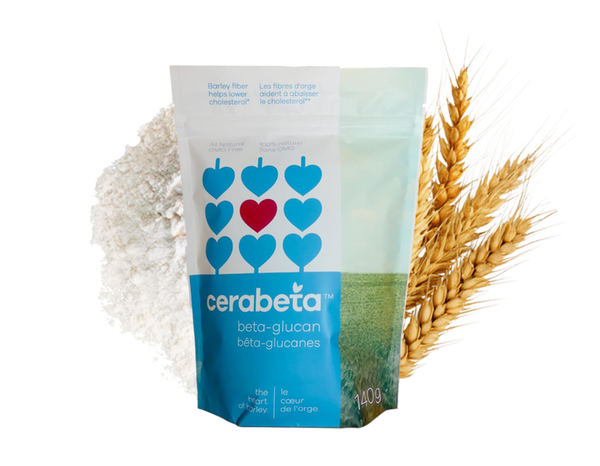
Dr. Rhonda Patrick talked about beta-glucan three times between June and August 2026: a FoundMyFitness episode and video on June 14, The Mel Robbins Podcast on June 25, and a second FoundMyFitness episode on August 4. Below is what she covered, and our plain answers to the questions she raised.
Dr. Rhonda Patrick is not affiliated with Cerabeta and is not paid by us. This page is not an endorsement by Dr. Patrick or by The Mel Robbins Podcast.
What she said
FoundMyFitness, June 14, 2026. In the clip "Scientists Discovered a Supplement That Lowers Cholesterol AND Excretes Toxins," Dr. Patrick compared beta-glucan with psyllium for LDL cholesterol, talked about how much it lowers LDL, covered early research on PFAS, and said what she looks for in a product: clear beta-glucan content and testing. She named Cerabeta as the product she chose. Links: video (she names Cerabeta at 7:47), episode page.
"I selected a Canadian barley beta-glucan product called Cerabeta and disclosed that I have no affiliation with the company." Dr. Rhonda Patrick, FoundMyFitness
The Mel Robbins Podcast, episode 408, June 25, 2026. In "Change Your Body at Any Age: The Diet & Exercise Plan For a Longer Life," Dr. Patrick walked through her daily smoothie and described a beta-glucan powder made from barley. She mentioned research on LDL cholesterol and on forever chemicals, and noted how few people get enough fiber. Links: video (her smoothie segment starts at 1:01:56), episode page.
"It's a beta glucan powder made from barley." Dr. Rhonda Patrick, The Mel Robbins Podcast
FoundMyFitness, August 4, 2026. Dr. Patrick came back to beta-glucan in a second episode. She explained how it lowers LDL cholesterol: it binds bile acids in the gut, so the liver pulls more cholesterol from the blood to make new bile. She also covered the early PFAS research again and why dose and product testing matter. She did not name a product in this episode. Link: episode page.
Our answers to the questions she raised
Which beta-glucan did Dr. Rhonda Patrick choose? On FoundMyFitness on June 14, 2026, Dr. Patrick said she selected Cerabeta, a Canadian barley beta-glucan, and that she has no affiliation with the company. Cerabeta is made from barley in Camrose, Alberta, using a patented process that uses air, with no chemicals or enzymes. Dr. Patrick is not affiliated with Cerabeta and is not paid by us.
Barley beta-glucan or psyllium? Both are soluble fibers, but they are not made the same way. Cerabeta is barley beta-glucan, separated from non-GMO barley by a patented natural air process, with no chemicals or enzymes. It works at 3 g a day, which is 3 tablespoons of Cerabeta stirred into coffee, yogurt or hot cereal. Psyllium husk is taken in larger amounts and thickens quickly, so it is usually mixed into a full glass of water and drunk right away.
How much does LDL drop? In a meta-analysis of 8 trials, barley lowered LDL by about 10 mg/dL on average, in studies that ran 4 to 12 weeks (Talati 2009). Your result depends on your starting LDL, your diet and your genetics. The only way to know is a lipid panel after 12 weeks of daily use. Our guide explains the full plan: https://cerabeta.com/pages/lower-ldl-cholesterol-naturally
Does barley beta-glucan contain gluten? Yes. Barley contains hordein, a protein in the gluten family. Cerabeta has about 80 ppm. That is low, but Cerabeta is not suitable for anyone with celiac disease or a severe gluten intolerance.
What about PFAS, the forever chemicals? PFAS build up in the body over years, and researchers are starting to ask whether fiber can help lower the amount in the blood. A 2025 study measured blood PFAS levels in people taking beta-glucan, and Dr. Patrick described the result as an early signal rather than proof. This research is still emerging. We make no claim that Cerabeta lowers PFAS, and we will update this page as more is published.
What should I look for in a product? Check that the label gives grams of beta-glucan per serving, not just grams of fiber, so you know you are reaching 3 g a day. Three tablespoons of Cerabeta give you 3 g of barley beta-glucan, the amount in the FDA-recognized health claim. Cerabeta is made from non-GMO barley in Camrose, Alberta, Canada, using a patented process that uses air, with no chemicals, enzymes or water. Look for high molecular weight beta-glucan too: it forms the gel that lowers LDL. Cerabeta's air process keeps the beta-glucan's natural high molecular weight.
How to take it
- Week 1: 1 tablespoon a day.
- Week 2: 2 tablespoons a day.
- Week 3 onward: 3 tablespoons a day, which gives you 3 g of barley beta-glucan.
Stir it into water, coffee, a smoothie, yogurt or hot cereal. Keep going for 12 weeks, then retest. If you take cholesterol medication or any other prescription, keep taking it as prescribed and talk to your doctor or pharmacist before you start.
What the regulators say
- FDA. "Soluble fiber from foods such as [barley], as part of a diet low in saturated fat and cholesterol, may reduce the risk of heart disease," based on 3 g or more a day of beta-glucan soluble fiber. Source: https://www.ecfr.gov/current/title-21/chapter-I/subchapter-B/part-101/subpart-E/section-101.81
- Health Canada. Health Canada licenses barley beta-glucan natural health products to help reduce/lower LDL cholesterol (which is one risk factor for the development of coronary heart disease) at 2 to 10 g of beta-glucan a day, and accepts "Barley fibre helps reduce/lower cholesterol" for barley foods, based on 3 g a day. Source: https://www.canada.ca/en/health-canada/services/food-nutrition/food-labelling/health-claims/assessments/assessment-health-claim-about-barley-products-blood-cholesterol-lowering.html
- Europe (EFSA). EFSA's scientific panel concluded that barley beta-glucan helps maintain normal blood LDL cholesterol at 3 g a day. Source: https://efsa.onlinelibrary.wiley.com/doi/abs/10.2903/j.efsa.2011.2207
Next step
Try 12 weeks of barley beta-glucan. Subscribe and join the Success Program.
This page is for general education and is not medical advice. Talk to your doctor or pharmacist before changing your diet, medications or supplements.
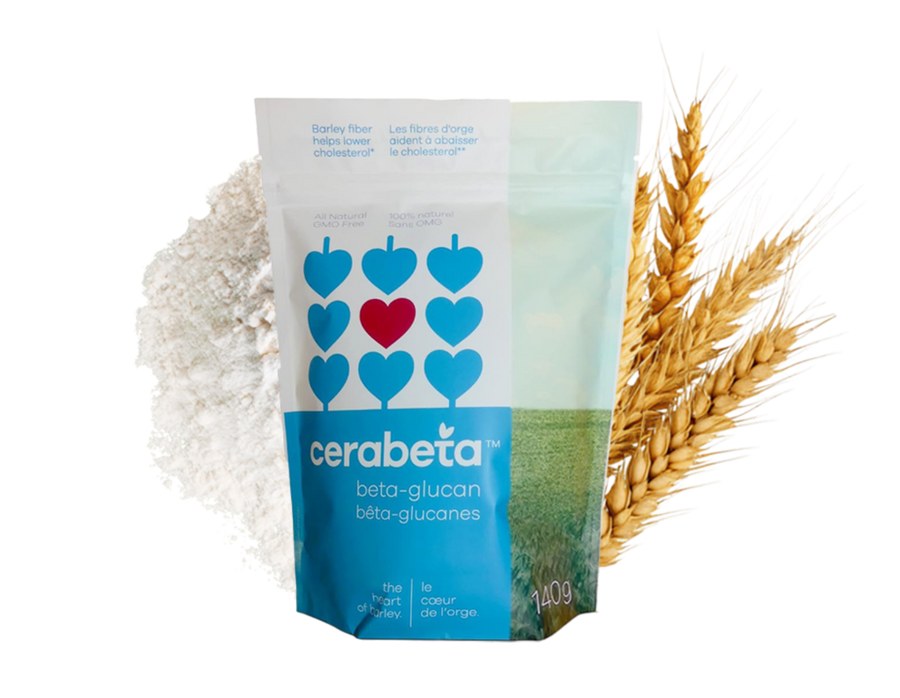
Ready to try Cerabeta?
- Barley beta-glucan from Canadian non-GMO barley
- No sugar, no sweeteners, no taste
- Mixes into coffee, oatmeal, yogurt or a smoothie
- Subscribe to join the Success Program: a plan for your goal, a welcome kit and email support
- About $1.64 a day on a two-bag subscription, with free shipping
One bag lasts about two weeks at 3 tablespoons a day.